
 Elizabeth Rosenthal's searing article about medical billing, adapted from her forthcoming book An American Illness, is well worth a read. Its topic of sophisticated medical billing/upcoding -- done by organizations ostensibly acting in the best interests of patients and often under the guise of a non-profit status -- is also worthy of a discussion itself. This is not that discussion. What jumped out to me (and to many others, on Twitter and elsewhere) was the following indictment: "In other countries, when patients recover from a terrifying brain bleed — or, for that matter, when they battle cancer, or heal from a serious accident, or face down any other life-threatening health condition — they are allowed to spend their days focusing on getting better"...
Feature Articles
2 Tools for Transforming Senior Management into Open Leaders
 This is the third article in our "Open Leadership Development" series. In part 1, I shared how we got started with building a leadership development system for our open organization. In part 2, I walked through four stages of leadership development in an open organization. Now, I'd like to share some leadership tools we've created for our open organization and published on GitHub under a Creative Commons license. One of my favorite homegrown pieces of our open leadership system is the OPT model, which was developed by my colleague Jan Smith, based on her observations within Red Hat and experience working with various leadership models. As you'll see, it's a strengths-based approach to development...
Peering into Complex, Tiny Structures with 3D Analysis Tool Tomviz
 New open source software tomviz—short for tomographic visualization—enables researchers to interactively understand large 3D datasets. More specifically, the software analyzes 3D tomographic data similar to a medical CT-scan but at the nanoscale. "When you can take a nanoparticle or biomolecule and spin it around, slice it, look inside it, and quantitatively analyze it, you get a complete picture from all angles," says Yi Jiang, a physics Ph.D. candidate at Cornell University. Watch this 3-minute video from the Michigan Engineering department....
Crowdfunding for Healthcare
Upbeat, Collaborative, and Focused: Educators at SXSWedu Reflect on the Value and Future of Citizen Science in Education
 These were some of the questions we set out to discuss at the Citizen Science Meet-up at SXSWedu. SXSWedu is an annual conference that attracts thought-leaders from the worlds of education, technology, policy, and the media. This year, 7,000 participants from 38 countries—including bestselling authors, TED-talking professors, and quirky teachers—came together to discuss the future of teaching and learning. At SciStarter and the California Academy of Sciences, we believe that citizen science is an integral part of that future, so we joined forces to bring our ideas to the participants of SXSWedu...
Halamka Recounts Early Experiences with Ambient Listening Devices (Alexa and Google Home)
 Beth Israel Deaconess Medical Center (BIDMC) has a long tradition of testing speculative technologies with the notion that breakthroughs often require tolerance for failure. For example, we’ve embraced blockchain in healthcare because we believe public ledgers have promise to unify medical records across institutions. Over the past few months, we’ve developed healthcare applications for Alexa, Amazon’s ambient listening device that combines natural language processing and easy to use application program interfaces. We have also tried Google Home. Here’s our experience thus far...
How the Open Knowledge Lab is Using Open Source Smog Sensors to Improve Air Quality in Germany
 Stuttgart, Germany has, like many other cities, a smog problem—even if it may be less severe than in other cities. The European Union has defined a threshold of on average 50 micrograms of dust particles per cubic meter in a 24-hour window of air to be allowed for a maximum of 35 days a year. For the last few years, actual values have been much higher for more than 35 days. There are governmental stations that measure the air pollution, but they can’t be everywhere for obvious reasons. The Open Knowledge Lab in Stuttgart, Germany has begun to develop their own IoT sensors that measure air quality every minute and report the data to a central server. It is then possible to display the smog levels on a map. See the map we're using...
Sometimes Innovation Requires Disobedience
The M.I.T. Media Lab is taking nominations for its Disobedience Award, which was first announced last year. As the award's site proudly quotes Joi Ito, the Director of the Lab and who came up with the idea: "You don't change the world by doing what you are told." I love it. The site, and the award's proponents, make clear that they are not talking about disobedience for the sake of disobedience. It's not about breaking laws. They're promoting "responsible disobedience," rule-breaking that is for the sake of the greater good. The site specifies...
How a Lifecycle Management Tool Uses Metrics
 Greg Sutcliffe is a long-time member and now community lead of the Foreman community. Foreman is a lifecycle management tool for physical and virtual servers. He's been studying how the real-world application of community metrics gives insight into its effectiveness and discovering the gap that exists between the ideal and the practical. He shares what insights he's found behind the numbers and how he is using them to help the community grow...
Alangi Derick: Wikimedia’s First African Contributor to Google Summer of Code
 Alangi Derick comes from Buea, Cameroon. He joined the Wikimedia movement to develop his skills in coding, and was quickly hooked by the movement’s values and its community culture, eventually becoming a staunch advocate for it in his university. As a computer science student at the time, he joined the movement a year and a half ago, and his work booked him a place at the 2016 Google Summer of Code as one of the Wikimedia Foundation’s students. Derick passed the program, helped mentor teenage participants in Google Code-in for two consecutive years, and has helped fix bugs in the MediaWiki software...
Gathering for Open Science Hardware 2017: Building a Movement
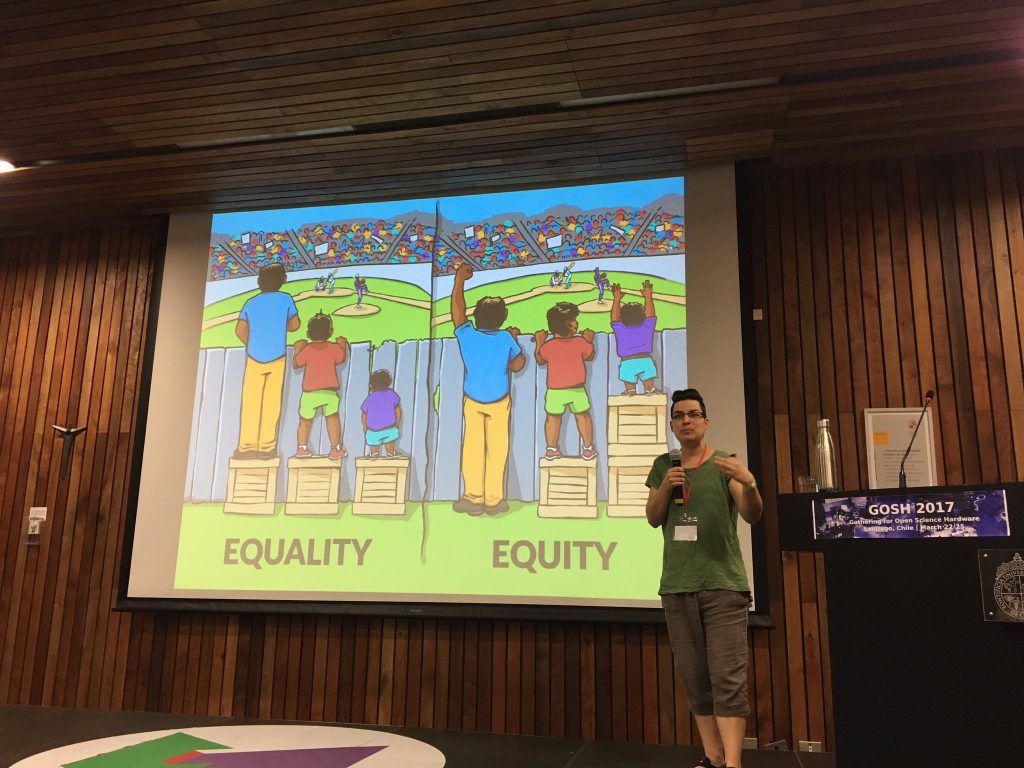 Without hardware, there is no science. Instruments, reagents, computers, and lab equipment are the platforms for producing systematic knowledge. Innovations from lenses to atomic force microscopes to DNA sequencers to particle accelerators have opened up new fields of knowledge with huge potential impacts for science and society. However, participants in the Gathering for Open Science Hardware, currently taking place at the Innovation Centre, Pontificia Universidad Católica de Chile, argue that limited access to scientific tools impedes the progress and reach of science. Black-box scientific tools block creativity and customization through high mark-ups and proprietary designs, compounded by intellectual property restrictions...
Open Source Job Opportunities Grow at Humanitarian Crisis Relief Groups
 Typically, when a crisis group or organization is faced with a humanitarian emergency, they tend to focus on what has worked in the past because new solutions need to be tested prior to an emergency. We also see that volunteers for these groups/organizations are usually the first to bring an open source tool or project to the table as a potential solution. With a greater influx of open source tools being used in crisis situations, organizations are realizing the power of open source to allow them to adapt technology quickly in a changing environment and to work together across organizations.
OpenMRS Google Code-In Student Mira Yang Wins Grand Prize
 Mira Yang, an 11th grade student at Union County Magnet High School in NJ, USA and OpenMRS community member has won the 2016 Google Code-In Grand Prize! Miss Yang is a volunteer with the American Red Cross, the American Cancer Society, and a local hospital for children with special needs, who wants to use her computer science skills to assist diagnosing and treating patients in the field of medicine...
Kenya Creates Online System to Monitor Rural Sanitation
 Kenya has launched an online monitoring, evaluation and reporting system to improve capturing of data on sanitation and hygiene status, a conference has heard. According to Kenya’s Ministry of Health, the country has open defecation rate of 14 per cent, with countries such as Wajir and Turkana having a rate of 76.7 and 82.2 per cent respectively. The online portal could help coordinate monitoring of water, sanitation and hygiene (WASH), and enable public health officials in rural areas facilitate rapid acceleration of the Open Defecation Free (ODF) campaign, experts say...
The Age of Hacking Brings a Return to the Physical Key
 With all the news about Yahoo accounts being hacked and other breaches of digital security, it’s easy to wonder if there’s any real way to keep unauthorized users out of our email and social media accounts. Everyone knows not to use the same username and password combination for every account – though many people still do. But if they follow that advice, people end up with another problem: way too many passwords to remember – 27 on average, according to a recent survey. That can lead to stress about password security, and even cause people to give up secure passwords altogether. It’s an ominous feeling, and a dangerous situation...
Is the Future of mHealth Based on SMS and Inexpensive Mobile Phones?
 Earlier this month the Finnish mobile phone maker, Nokia, announced that they will be re-releasing an updated version of their legendary 3310 GSM phone. Since it was first released in the early 2000s, the Nokia 3310 has gained a cult following for its incredible durability, long battery life and compact design featuring an internal antenna. Many Europeans and Americans fondly remember the 3310 as their first mobile phone, a device that made meeting up with friends in a crowd easier and a device that provided endless hours of entertainment with the timeless game Snake...