
 What began as a ripple with the goal to make research accessible and free has propagated into over 157 funder and 500 university policies that provide millions of readers around the world increasing opportunities to make important, positive impacts on global health, scientific discovery, policy and education. This wave of Open Access–and now Open Science–moving through the scientific community has created a scientific publishing ecosystem that spreads beyond researchers, reviewers, editors and funders to include technologists, institutions, patients, entrepreneurs and librarians...
 Just because Steve Wozniak takes a shot at Apple doesn't mean he's wrong. Woz recently declared that the current generation of wearables, including the Apple Watch, are "not a compelling purchase." He says that his Apple Watch is "an expense that has brought me a few extra niceties in my life," but generally is frustrated that wearables don't have enough computing power and are mostly still dependent on a linked smartphone for many of their functions. He's not alone in his skepticism. A trio of analysts from Pacific Coast Securities see trouble ahead for many wearable manufacturers, as "value creation shifts away from the thing itself, while the associated ecosystem, software and/or service tend to deliver the real intelligence that the things provide"...
 In September 2014, the president committed to creating a federal open source policy that improved citizen access to software developed by the Federal government. I wrote back then about what I was optimistically hoping to see. Today, public comments close on a federal source code policy that initiates a three-year pilot program to make as little as 20% of new government software available to the taxpayers who fund it and for whom the software’s intended to benefit. In a world increasingly dominated by the success of open source, requiring that the world’s largest producer of code releases only 20% of its software is a missed opportunity to modernize government that fails to live up to the president’s National Action Plan commitments.
 I just realized that I hadn't ever really written about two hot trends in health care: bionics and 3D printing. I better get to it before they become mainstream, or are superseded by something even newer. Let start with bionics. According to Merriam-Webster, bionic means "having normal biological capability or performance enhanced by or as if by electronic or electromechancial devices." Bionics is the science of this...Bionics is estimated to be an $8b market (2014), with a projected 13.2% CAGR that would bring it to $20.5b by 2020. The artificial kidney market is said to account for some 60% of the market, with livers expected to be the fastest growing segment over the period.
 One of the top-rated apps in the Google Play Store right now when you search for glucose tracker is Glucosio. The app is designed to track blood glucose test results, and after installing it to test it out, I found it easy and simple to use, with not a lot of settings to deal with to get straight to using it. In just a few short months since its release in October 2015, Glucosio has received great ratings and reviews and over a thousand downloads. Glucosio was also recently listed on Black Duck's list of Open Source Rookies of the Year, which honors innovative, sophisticated projects in open source...
 At this year’s HIMSS conference, interoperability was again one of the hottest topics of discussion. Interoperability was even a featured showcase at the HIMSS Interoperability Showcase. Yet the lack of interoperability in HealthIT remains. "HealthIT is not unique in its interoperability woes and other industries, including the automotive industry, are still struggling with associated safety issues."
 Ethereum, which provides a distributed database (no central repository) for the purpose of tracking financial transactions. I immediately thought of the challenge we have turning silos of medical information into a linked, complete, accurate, secure, lifetime medical record. Might blockchain technology be useful in healthcare? I posted the question to my colleagues, Arien Malec (VP, Data Platform and Acquisition Tools at RelayHealth and the new Chair of the HIT Standards Committee) and David McCallie (SVP of Medical Informatics at Cerner).
 The fact is, most of healthcare simply doesn’t spend enough on data security. In a study conducted by HIMSS Analytics and Symantec that polled 115 IT and security professionals in hospitals with more than 100 beds, more than half (52 percent) said their organization dedicated between zero and 3 percent of the IT budget to security. Just 28 percent said they spent between 3 and 6 percent of IT budget on security. “All of this makes healthcare organizations rich targets for cybercriminals,” reads the study summary.
 Rats! I was all excited to write about virtual reality -- what with the long-anticipated release of the Oculus Rift -- or about how perhaps augmented reality is going to be the new reality, as some experts predict. Then Consumer Reports came out with a report that I had to write about: What You Don't Know About Your Doctor Could Hurt You. Long story short: chances are you don't know what you'd like to. Consumer Reports did a deep dive on the actions of the California medical board, obtaining their entire database of doctors on probation...
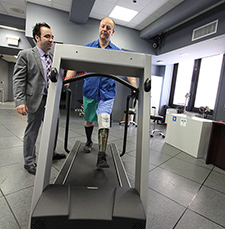 Prosthetics has come a long way—witness the $35,000 computerized knee that sits on a table in Maikos' Gait and Motion Analysis Lab, coupled with a $30,000 bionic foot. The high-tech components are awaiting testing with Veteran amputees who come to the lab. Some have lost a leg to an IED or rocket-propelled grenade in Iraq or Afghanistan—or perhaps to a mine or mortar blast decades ago in Vietnam. Others have lost a foot or leg in an accident, or to diabetes or vascular disease. The purpose of the tests is twofold: to help determine the best prescription for the Veterans, and to gather research data. Along with gait abnormalities, Maikos studies functional outcomes such as walking speed and distance.
 In this article, I'll look at community from a business perspective, including the effect community can have on an organization's bottom line. Although there are communities everywhere, I'll approach the topic—meaning, communities, their members, and their contributors—from a free/open source perspective. So please stick around, and maybe you'll learn ways to communicate the importance of community to your organization...
 Many existing vendors recognize the need to move open standards, open data and open interfaces (APIs) but while some are moving in the right direction, they are not there yet Others drag their feet knowing their current success relies on existing proprietary solutions, customer lock and their pseudo-ownership of customer data. Getting to the tipping point at which open platforms can really take off is going to require new players challenging the status quo and a willingness from the health and care community to help them successfully engage.